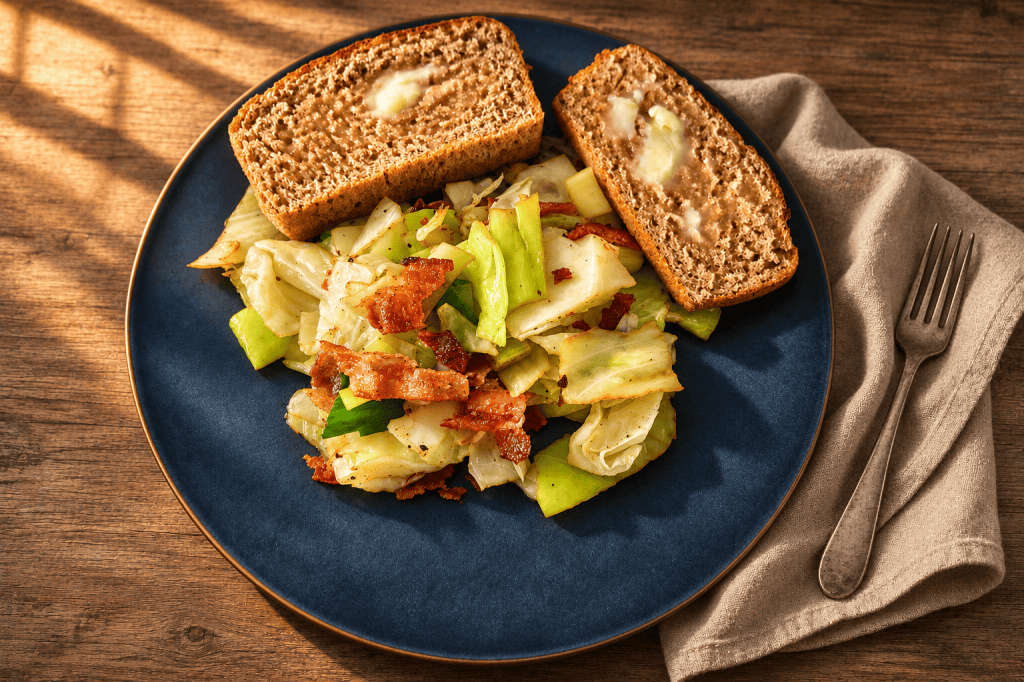
Bacon, Cabbage & Leeks with Spelt Hearth Bread
There are meals meant to impress a crowded hall, and there are meals meant to restore someone who has come in from the cold.
This is the second kind.
A skillet of slowly rendered bacon, softened cabbage, and buttery leeks does not require rare spices or elaborate technique. It asks only for patience, a few sturdy ingredients, and enough bread to catch every last bit from the pan.
Pile it over a thick slice of toasted spelt bread and it becomes the sort of supper that feels best eaten near a fire while rain strikes the windows—a meal from an imagined tavern at the edge of the woods, where the road has disappeared into darkness and no one expects you to leave before morning.
Hearth Food, Not Feast Food
When we picture medieval food, it is easy to imagine banquet tables crowded with roasted animals, jeweled pies, and costly imported spices. Those meals existed, but they belonged to only a small part of medieval life.
Most food was quieter.
Cooking was commonly done over a central hearth, where meat and vegetables could be boiled or simmered together in a large pot. Cabbage, onions, leeks, beans, turnips, and other dependable garden crops added substance to everyday meals. Pork was eaten fresh when available, while salt made it possible to preserve meat for later use.
Archaeologists have even found evidence of cabbage and leeks in residue left inside medieval cooking vessels. Leeks were grown in manor gardens for use in the pottage served to workers, while cabbage was among the vegetables that could withstand a cool climate and help carry a household through the less generous months.
This recipe is not a reconstruction of one named medieval dish. Instead, it is built from the sort of durable ingredients and practical cooking methods that would have been familiar in historic European kitchens.
The Leek: From Garden to Legend
The leek is an ordinary vegetable with an unusually heroic reputation.
According to Welsh legend, Saint David instructed Welsh soldiers to wear leeks on their helmets so they could recognize one another during battle against the Saxons. Another tradition connects Welsh archers and a field of leeks with the Battle of Crécy in 1346.
These stories are legends rather than firmly documented events, but the leek’s place in Welsh identity is very real. By the 16th century, it was already closely associated with Saint David’s Day, and it remains one of the national emblems of Wales.
It is a fitting transformation for such an unassuming plant: something grown in kitchen soil becoming a symbol of belonging, endurance, and the ability to recognize one’s own people in uncertain conditions.
Just remember to wash it thoroughly first. A symbolic connection to the land is lovely. Actual dirt between your teeth is not.
Bread at the Center
Bread was not simply another item placed beside a medieval meal. For many people, it was the meal’s foundation.
It was eaten with smaller portions of meat, fish, cheese, or vegetables. In late medieval England, those accompanying foods could collectively be described as companagium—literally, that which is eaten with bread.
Bread was portable enough to carry into fields, forests, workshops, and along pilgrimage roads. It could be eaten fresh, dried for storage, softened in broth, or used as a trencher beneath other foods. Sharing it also carried meanings beyond nourishment: hospitality, charity, fellowship, and provision.
Our spelt loaf is not presented as a reconstruction of the typical bread eaten in medieval England. Archaeological evidence from medieval English sites more commonly points to bread wheat, rye, barley, and oats, while spelt has a much older history extending back into the ancient world.
Here, spelt earns its place because it creates exactly the bread this meal wants: rustic, tender, lightly nutty, and sturdy enough to hold a generous spoonful of bacon, cabbage, and leeks.
The Woodland Tavern Supper
Begin with the bread. Its resting and rising time gives you plenty of room to prepare the skillet while the loaf bakes and cools.
The Foolproof Spelt Hearth Loaf
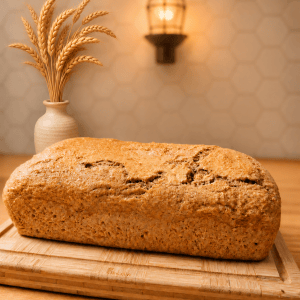
No kneading stress. No perfection required.
This is a rustic loaf. It is supposed to look like it belongs on a wooden board beside a fire. The dough needs only a brief fold rather than prolonged kneading, making it an approachable companion for soups, stews, and a skillet of bacon, cabbage, and leeks.
Yield: 1 loaf
Active time: About 15 minutes
Rising and resting time: 1 hour 40 minutes–2 hours 20 minutes
Bake time: 30–35 minutes
Ingredients
- 3 cups spelt flour, whole or white
- 1¼ cups warm water—not hot; think “nice bath”
- 2 teaspoons instant yeast
- 1½ teaspoons salt
- 1 tablespoon honey or maple syrup
- 2 tablespoons olive oil or melted butter
Instructions
- Mix the dough.
Add the warm water, yeast, and honey to a large ceramic mixing bowl. Stir gently, then add the olive oil or melted butter. Add the spelt flour and salt. Mix with a sturdy spoon or your hands until the ingredients are completely combined. The dough will be very wet, sticky, and loose—more like a thick blob than a dough that can hold a ball. That is exactly how spelt dough should look. Do not keep adding flour in an attempt to make it behave like ordinary bread dough. If it can stand up neatly on its own, it is probably too dry. This will feel incredibly unnatural and wrong if you’re used to making normal bread. Just trust the process. - Let it rest.
Cover the bowl with a clean kitchen towel and leave the dough undisturbed for 20–30 minutes. This gives the spelt flour time to absorb the water and allows the dough to begin developing structure without requiring much effort from you. - Give it a few gentle folds.
Wet your hands to prevent sticking. Lift one side of the dough, fold it toward the center, and repeat a few times around the bowl. This should take about one minute. The dough will still be sticky and loose afterward. There is no kneading marathon, no wrestling, and no expectation that it will suddenly agree to hold a shape. - Allow the first rise.
Cover the bowl again with the towel and let the dough rise for 60–90 minutes. It is ready when it looks soft and airy, has become slightly puffy, and has grown to approximately 1½ times its original size. If it rises a little longer than intended, it will be fine. This loaf is forgiving. - Transfer it to the loaf pan.
Lightly grease a standard loaf pan or line it with parchment paper. Use a flexible spatula or dough scraper to transfer the dough into the prepared pan. Do not attempt to shape it on the counter. The loaf pan is what gives this dough its structure while it rises and bakes. Smooth the top gently with a wet spatula or damp fingers, without pressing out the air. - Let it rest again.
Cover the loaf pan lightly with the kitchen towel and let the dough rest for 20 minutes while the oven preheats to 425°F. If desired, place an oven-safe pan of hot water on the lower rack to create steam and encourage a rustic crust. - Bake the loaf.
Bake for 30–35 minutes, until the top is golden and the loaf sounds hollow when tapped after being removed from the pan. If the top begins browning too quickly, loosely cover it with aluminum foil for the remainder of the baking time. - Let it cool.
Remove the bread from the loaf pan and transfer it to a cooling rack. Wait at least 20 minutes before slicing. This is unquestionably the most difficult step.
What to Expect
- A tender crumb
- A light chew
- A soft interior
- A rustic crust that will not threaten the structural integrity of your teeth
- Dough that behaves like a sticky blob before baking and perfectly good bread afterward
If it does not look “perfect,” it will still be good. That is the magic.
Woodland Tavern Bacon, Cabbage & Leeks
Slow-cooked bacon, tender cabbage, and buttery leeks are finished with a splash of apple cider vinegar, then piled over toasted spelt bread for a simple, deeply satisfying meal.
Yield: 4 hearty servings
Prep time: 15 minutes
Cook time: 30–35 minutes
Ingredients
- 12 ounces thick-cut bacon
- ½ medium head green cabbage
- 1½ large leeks, white and light-green portions included
- Salt, to taste
- Freshly ground black pepper, to taste
- 1 tablespoon apple cider vinegar, plus more if desired
- Toasted spelt bread, for serving
Instructions
- Place the bacon in a large, cold skillet or Dutch oven. Cook slowly over medium-low heat, turning occasionally, until browned and crisp. Taking your time allows the fat to render without burning the bacon—and that bacon grease is an important part of the dish.
- While the bacon cooks, remove the tough outer leaves and core from the cabbage. Roughly chop half of the head, wash it thoroughly, and allow it to drain well.
- Trim the root end and dark-green tops from the leeks. Slice the white and light-green portions, then wash them especially well. Leeks are very good at hiding actual soil between their layers, and we are not aiming for a literally earthy flavor.
- When the bacon is cooked, transfer it to a plate and set it aside. Leave the rendered bacon grease in the pan.
- Add the chopped cabbage and leeks to the bacon grease. Season with a light dusting of salt and black pepper, remembering that the bacon will add more salt when it returns to the pan.
- Cook over medium-low heat, stirring occasionally, until the cabbage and leeks are soft and reduced, about 15–20 minutes. Cover the pan for part of the cooking time if the vegetables need help softening, removing the lid near the end so any excess moisture can evaporate.
- While the vegetables cook, roughly chop or crumble the bacon.
- Return the bacon to the pan. Add 1 tablespoon of apple cider vinegar and toss everything together until evenly coated. Taste and add another small splash of vinegar, salt, or pepper if needed.
- Serve hot with thick slices of toasted spelt bread. For the full woodland-tavern experience, pile the bacon, cabbage, and leeks directly over the toast and allow the bread to catch the savory juices.
Hearth Note
This is the sort of meal that makes a dark, stormy evening feel like a destination rather than an inconvenience: a hot skillet, a thick piece of bread, and something simple and sustaining spooned over the top.
To Serve
Toast thick slices of the spelt bread until the edges become lightly crisp. Set each slice on a plate or shallow bowl, then pile the warm bacon, cabbage, and leeks over the top.
The bread will soften beneath the vegetables while keeping a little chew around the edges. Add another small splash of apple cider vinegar if you prefer a brighter finish.
No medieval costume is required.
A dark evening, steady rain, and an unreasonable number of candles are encouraged.
A Meal Worth Carrying Forward
History is not found only in royal kitchens or elaborate feast-day recipes. It also lives in the habit of making something sustaining from what is close at hand.
Cabbage from the garden. Leeks pulled from cool soil. Pork preserved against scarcity. Grain transformed into bread. A hot meal shared before the fire goes low.
The ingredients are humble, but humble does not mean joyless. Sometimes the simplest food is the easiest to imagine carrying across centuries: warm, savory, filling, and still worth scraping from the bottom of the pan.
Sources and Further Reading
- Christopher Dyer, “A Simple Food with Many Meanings: Bread in Late Medieval England”
- The Herbert Art Gallery & Museum, “Historic Cooking: Medieval Cooking”
- Historic England, “Medieval Plant Remains from Watergate Street, Chester”
- Museum Wales, “St David’s Day in Wales: History, Traditions and Symbols”

