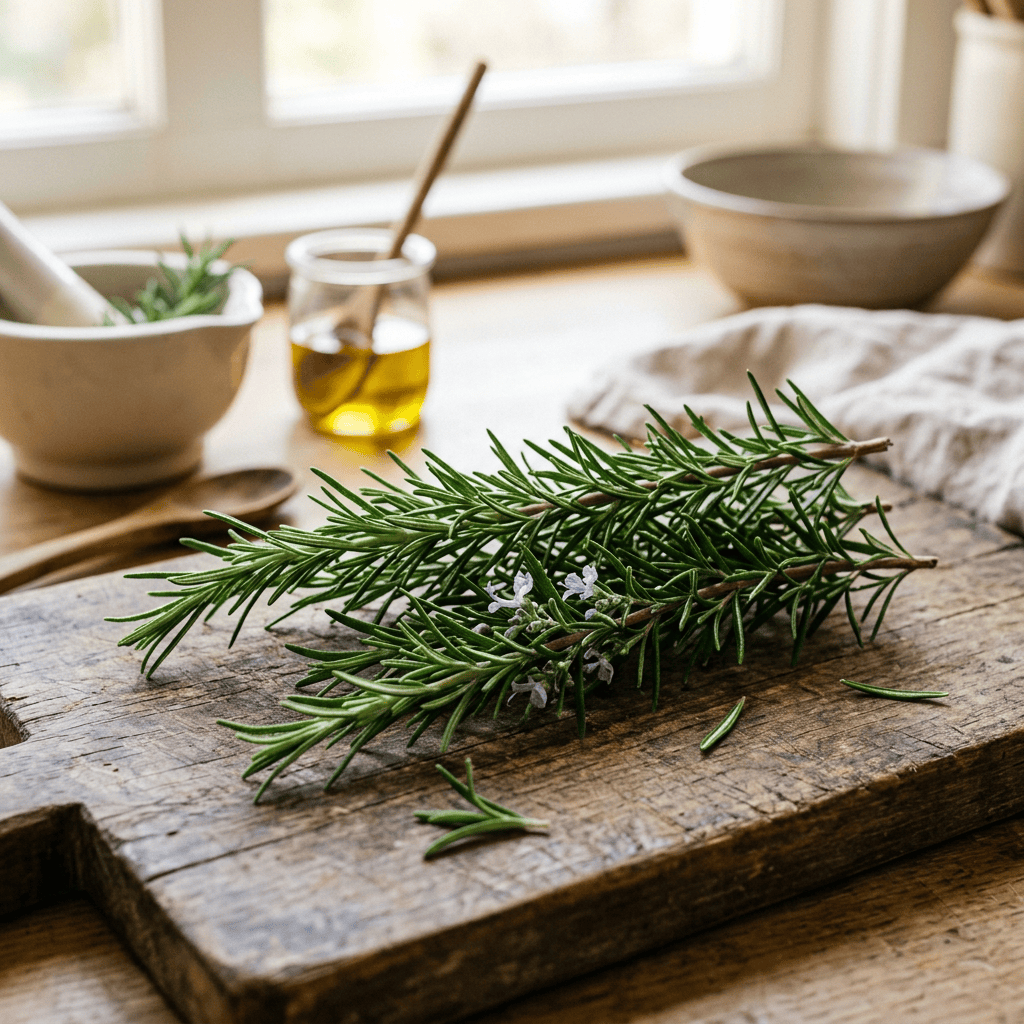
Rosemary has followed us for centuries—from sun-warmed Mediterranean hillsides to kitchen gardens, wedding garlands, old remedies, and loaves pulled fragrant from the oven. Its name is often translated as “dew of the sea,” but this familiar herb carries far more than a beautiful name. It holds stories of memory and remembrance, practical wisdom for the garden and kitchen, and a flavor capable of making even a humble loaf feel like an occasion.
Rosemary
At a Glance
Botanical name: Salvia rosmarinus
Formerly known as: Rosmarinus officinalis
Family: Lamiaceae—the mint family
Native home: The Mediterranean region
Plant type: Aromatic evergreen shrub
Flavor: Piney, woodsy, peppery, and slightly bitter
In the Garden
Rosemary is a sun-loving Mediterranean herb that prefers light, freely draining soil and would strongly rather not sit with wet roots—especially through winter. Once established, it handles dry conditions well and rewards a sunny position with fragrant foliage and small flowers that can range from pale blue to purple, pink, or white. Depending on the variety and climate, it may grow as a compact container plant, trail over a wall, or become a substantial woody shrub.
A Herb with a Long Memory
Rosemary grew naturally along the dry, sunlit edges of the Mediterranean long before it found a permanent place in kitchen gardens. The Romans knew it as rosmarinus—a name traditionally interpreted as “dew of the sea”—and cultivated it for its fragrance, flavor, and usefulness. Traces of rosemary have even been identified among the plant remains at Herculaneum, preserved beneath the eruption of Mount Vesuvius.
Yet rosemary was never only a kitchen herb. Across the ancient Greek and Roman worlds, it became closely associated with memory and appeared in ceremonial garlands, marriages, and funeral customs. The same evergreen sprig could accompany a joyful beginning or a final farewell: a symbol of fidelity for those joining their lives and remembrance for those honoring a life that had ended.
That meaning endured for centuries. When Ophelia says, “There’s rosemary, that’s for remembrance” in Shakespeare’s Hamlet, she is drawing upon symbolism her audience would already have understood. Perhaps that is rosemary’s oldest magic—not that it preserves memory by itself, but that its unmistakable scent can carry us instantly back to a person, a kitchen, or a particular season of our lives.
Folklore & Belief
Love & Fidelity
Rosemary once appeared at weddings as readily as it did at funerals. Brides wore it in wreaths or carried it among their flowers, while guests might receive gilded sprigs as tokens of loyalty and love. Some newly married couples were even said to plant rosemary together—a living wish that affection, fidelity, and the household itself would take root and flourish.
Protection at the Threshold
In European folk belief, rosemary was treated as a guardian of the home. Sprigs were hung near doors and windows, planted close to entrances, or burned for their sharp, cleansing fragrance. It was believed to discourage illness, troublesome spirits, and other things one would generally prefer not to invite inside.
Dreams & Remembrance
Placed beneath a pillow, rosemary was said to keep away nightmares, encourage pleasant dreams, and help the sleeper remember them by morning. Whether or not the sprig provided supernatural assistance, its fragrance made a fitting companion to memory: vivid, persistent, and nearly impossible to mistake for anything else.
From Garden to Table
For all its history and symbolism, rosemary remains wonderfully practical. A few fresh sprigs, a generous pour of olive oil, and a pan of soft dough are enough to turn it into something meant to be torn apart, passed around, and eaten while still warm.
Rosemary Focaccia
Golden at the edges, soft in the middle, and thoroughly dimpled with olive oil, this focaccia is forgiving enough for a first loaf and good enough to make store-bought bread feel like a personal insult.
Makes: One 9 × 13-inch focaccia
Active time: About 20 minutes
Rising time: 1½–2½ hours
Bake time: 20–25 minutes
Ingredients
- 1¼ cups warm water, plus more as needed
- 1 teaspoon sugar
- 2¼ teaspoons instant yeast (one packet)
- 3½ cups all-purpose flour
- 1½ teaspoons salt
- 1 teaspoon garlic powder
- 2½ tablespoons olive oil, plus more for the bowl, pan, fingers, and final drizzle
- Leaves from 2 sprigs fresh rosemary
- Flaky sea salt, for finishing
Optional Toppings
- Halved cherry tomatoes
- Thinly sliced or minced garlic
- Pitted olives—Kalamata olives would be divine
Instructions
Golden at the edges, soft in the middle, and thoroughly dimpled with olive oil, this focaccia is forgiving enough for a first loaf and good enough to make store-bought bread feel like a personal insult.
Makes: One 9 × 13-inch focaccia
Active time: About 20 minutes
Rising time: 1½–2½ hours
Bake time: 20–25 minutes
Ingredients
- 1¼ cups warm water, plus more as needed
- 1 teaspoon sugar
- 2¼ teaspoons instant yeast (one packet)
- 3½ cups all-purpose flour
- 1½ teaspoons salt
- 1 teaspoon garlic powder
- 2½ tablespoons olive oil, plus more for the bowl, pan, fingers, and final drizzle
- Leaves from 2 sprigs fresh rosemary
- Flaky sea salt, for finishing
Optional toppings
- Halved cherry tomatoes
- Thinly sliced or minced garlic
- Pitted olives—Kalamata olives would be divine
Instructions
- Wake up the yeast. In a small bowl, combine the warm water, sugar, and yeast. Let the mixture stand for 5–10 minutes, until it looks creamy or lightly foamy. If you become distracted and leave it for 15 minutes, the focaccia police will not come for you.
- Mix the dough. In a large bowl, combine the flour, salt, and garlic powder. Pour in the yeast mixture and 2½ tablespoons of olive oil, then stir with a spatula until a shaggy, sticky dough forms. If dry flour remains, add more warm water a few tablespoons at a time. The dough should feel soft and sticky, but it should still hold together rather than pour.
- Knead. Transfer the dough to a lightly floured surface and knead for about 5 minutes, until it becomes smoother and elastic. This requires a little muscle, so congratulations: bread and arm exercises are now the same activity.
- Let it rise. Lightly grease a clean bowl with olive oil—I use a paper towel to spread it around. Place the dough inside, cover the bowl with a damp kitchen towel, and leave it somewhere warm for 1–2 hours, or until roughly doubled in size.
- Prepare the pan. Generously coat a 9 × 13-inch pan with olive oil. Transfer the risen dough to the pan and gently stretch it toward the edges. If it springs back, let it rest for 5–10 minutes before stretching it again.
- Dimple and dress. Coat your fingertips with olive oil so the dough does not cling to them, then press deep dimples across the entire surface. Drizzle with more olive oil and scatter over the rosemary and flaky sea salt. Add tomatoes, garlic, olives, or any other toppings you have chosen.
- Let it rise again. Cover the pan with a towel and allow the dressed dough to rise for another 30 minutes.
- Bake. While the dough completes its second rise, preheat the oven to 425°F (220°C). Bake for 20–25 minutes, until the top is golden brown and the edges are crisp.
- Cool and serve. Let the focaccia cool slightly before lifting it from the pan and slicing—or tearing—it into generous pieces. It is best served warm, ideally beside soup, dipped in olive oil, or used to make a sandwich that ruins ordinary sandwich bread forever.

